
MI Cancer Seek™
Measures vs. Reports
Whole Exome and Transcriptome Sequencing with Clinically Focused Reporting
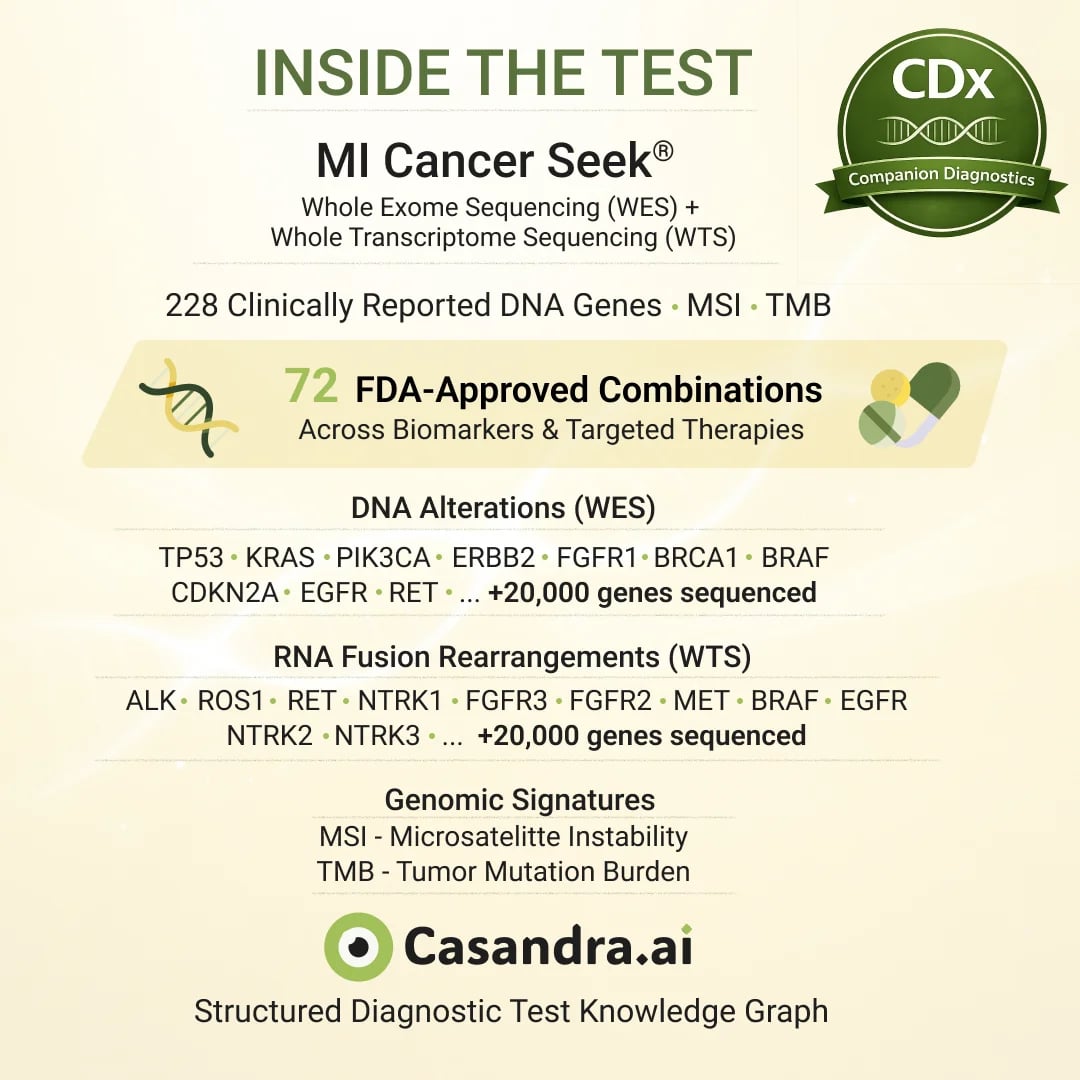
MI Cancer Seek isn't a gene panel.
Caris Life Sciences' MI Cancer Seek combines Whole Exome Sequencing (WES) and Whole Transcriptome Sequencing (WTS) to measure tumor biology across more than 20,000 genes.
What gets reported, however, is far more focused—prioritizing clinically actionable biomarkers for therapy selection.
What the Test Measures
Whole Exome Sequencing (WES)
- Broad DNA sequencing across more than 20,000 genes
- Detects mutations, insertions/deletions (indels), and copy number alterations
- Captures the full coding region of the genome
Whole Transcriptome Sequencing (WTS)
- RNA-based analysis across the transcriptome
- Enables detection of gene expression patterns and fusion events
- Supports identification of biologically relevant oncogenic drivers
What the Test Reports
DNA Alterations
- 228 clinically relevant genes reported
- Focused set derived from broader exome sequencing
- Includes key oncogenic drivers and actionable mutations
RNA Fusion Rearrangements
- Detection of clinically relevant gene fusions
- Includes drivers across major oncology pathways
Genomic Signatures
- MSI (Microsatellite Instability)
- TMB (Tumor Mutational Burden)
Why This Matters
These reported biomarkers support approximately 72 FDA-approved therapy–biomarker combinations across oncology indications.
Modern genomic assays are not defined solely by how much data they generate, but by how that data is filtered, interpreted, and translated into clinically actionable insights.
Understanding both what a test measures and what it reports is essential for appropriate test selection and result interpretation.
How Casandra Structures This
At Casandra.ai, we separate what a test measures from what it reports—capturing both the full scope of the underlying assay and the clinically relevant outputs.
By structuring diagnostic tests into components—methodology, biomarkers, measurement types, and clinical context—we enable a clearer understanding of how complex assays function and how they should be used.