
Signatera™
Personalized MRD Monitoring
Tumor-Informed ctDNA Analysis for Longitudinal Disease Tracking
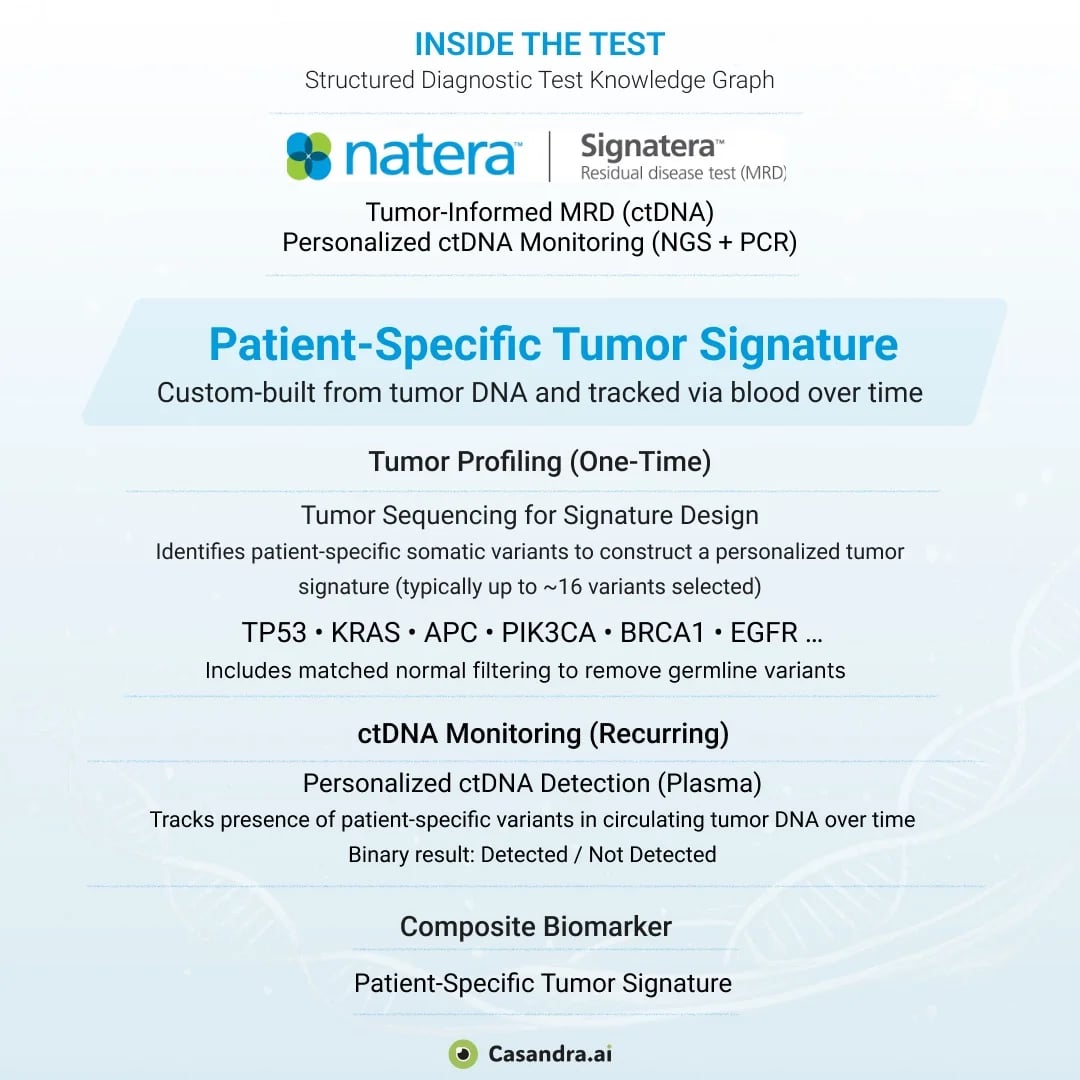
Signatera isn't a fixed test.
It's personalized to the patient.
Natera's Signatera is a tumor-informed minimal residual disease (MRD) assay that uses circulating tumor DNA (ctDNA) to track cancer over time. Instead of analyzing a fixed set of genes, it builds a custom assay for each patient based on their tumor.
How the Test Works
Tumor Profiling (One-Time)
- Sequencing of tumor tissue to identify patient-specific somatic variants
- Construction of a personalized tumor signature (typically ~16 variants)
- Establishes the targets for longitudinal monitoring
ctDNA Monitoring (Serial)
- Blood-based testing to detect patient-specific variants in circulating tumor DNA
- Repeated over time to assess disease status
- Enables longitudinal tracking of tumor dynamics
What the Test Reports
ctDNA Status
- ctDNA detected → evidence of residual disease
- ctDNA not detected → no molecular evidence of disease
Why This Matters
Because the assay is personalized, it can detect recurrence earlier than imaging and track treatment response over time.
Unlike comprehensive genomic profiling tests, Signatera is not used for therapy selection. It is designed for a different purpose: monitoring disease status and progression.
How Casandra Structures This
At Casandra.ai, we separate what a test measures from what it reports—capturing both the structure of the assay and the clinical output.
Some genomic tests analyze fixed gene panels. Some compare tumor to normal. Some analyze circulating DNA. Others are built uniquely for each patient.
Understanding these differences is essential to selecting the right test and interpreting results appropriately.